"/><stop offset="1" stop-color="rgba(255, 255, 255, 0.6)"/></linearGradient><linearGradient id="qavy54DcU-3748361077-linear-gradient" x1="0.49748743718592964" x2="0.5025125628140703" y1="1" y2="0"><stop offset="0" stop-color="rgba(255, 255, 255, 0.6)"/><stop offset="0.5" stop-color="rgb(255, 255, 255)"/><stop offset="1" stop-color="rgb(255, 255, 255)"/></linearGradient></defs><path d="M 15.754 9.25 C 17.821 9.25 19.663 10.217 20.849 11.72 C 21.602 8.508 23.24 5.631 25.49 3.362 C 22.807 1.256 19.426 0 15.754 0 C 7.051 0 0 7.042 0 15.725 C 0 24.408 7.051 31.45 15.754 31.45 C 17.366 31.45 18.921 31.207 20.388 30.759 L 20.388 20.255 C 19.169 21.501 17.498 22.202 15.754 22.2 C 12.169 22.2 9.268 19.302 9.268 15.725 C 9.268 12.148 12.172 9.25 15.754 9.25 Z" fill="rgba(255, 255, 255, 0.6)" height="31.450000000000003px" id="GdGhEU89V" width="25.490121951219518px"/><g d="M 5.095 27.408 C 6.224 28.423 7.614 29.279 9.002 29.938 C 11.048 30.907 13.335 31.45 15.751 31.45 C 17.364 31.45 18.919 31.207 20.383 30.759 L 20.383 20.255 C 19.206 21.455 17.566 22.2 15.751 22.2 C 12.167 22.2 9.264 19.302 9.264 15.725 L 5.095 15.725 Z M 25.488 3.362 C 23.238 5.631 21.6 8.508 20.847 11.72 C 19.66 10.217 17.821 9.25 15.754 9.25 C 12.169 9.25 9.266 12.15 9.266 15.725 L 0 15.725 C 0 7.042 7.049 0 15.751 0 C 19.424 0 22.805 1.256 25.485 3.362 Z M 0 37 L 0 15.494 L 9.268 15.494 L 9.268 27.75 C 9.268 32.858 5.118 37 0 37 Z" fill="transparent" height="36.99999866485596px" id="HmTq7bfqA" transform="translate(22.246 0)" width="25.487804878048752px"><path d="M 0 11.683 C 1.128 12.698 2.519 13.554 3.907 14.213 C 5.953 15.182 8.24 15.725 10.656 15.725 C 12.269 15.725 13.824 15.482 15.288 15.034 L 15.288 4.53 C 14.111 5.73 12.47 6.475 10.656 6.475 C 7.072 6.475 4.168 3.577 4.168 0 L 0 0 Z" fill="rgba(255, 255, 255, 0.6)" height="15.725px" id="hPupmQlUs" transform="translate(5.095 15.725)" width="15.288048780487806px"/><path d="M 25.488 3.362 C 23.238 5.631 21.6 8.508 20.847 11.72 C 19.66 10.217 17.821 9.25 15.754 9.25 C 12.169 9.25 9.266 12.15 9.266 15.725 L 0 15.725 C 0 7.042 7.049 0 15.751 0 C 19.424 0 22.805 1.256 25.485 3.362 Z" fill="url(%23NllbiafvP-3748361077-linear-gradient)" height="15.725000000000001px" id="NllbiafvP" transform="translate(0 0)" width="25.487804878048774px"/><path d="M 0 21.506 L 0 0 L 9.268 0 L 9.268 12.256 C 9.268 17.365 5.118 21.506 0 21.506 Z" fill="rgb(255, 255, 255)" height="21.50625px" id="Z3__vkUos" transform="translate(0 15.494)" width="9.268292682926823px"/></g><g d="M 15.756 0 C 7.053 0 0 7.042 0 15.725 C 0 24.408 7.053 31.45 15.756 31.45 C 24.459 31.45 31.512 24.411 31.512 15.725 C 31.512 7.039 24.457 0 15.756 0 Z M 15.756 22.2 C 12.172 22.2 9.268 19.302 9.268 15.725 C 9.268 12.148 12.172 9.25 15.756 9.25 C 19.341 9.25 22.244 12.15 22.244 15.725 C 22.244 19.3 19.338 22.2 15.756 22.2 Z M 0 15.725 L 9.268 15.725 L 9.268 27.801 C 9.268 32.879 5.137 37 0.051 37 L 0 37 Z" fill="transparent" height="37.00000038146973px" id="NvYsR5b0f" transform="translate(44.488 0)" width="31.512195121951223px"><path d="M 15.756 0 C 7.053 0 0 7.042 0 15.725 C 0 24.408 7.053 31.45 15.756 31.45 C 24.459 31.45 31.512 24.411 31.512 15.725 C 31.512 7.039 24.457 0 15.756 0 Z M 15.756 22.2 C 12.172 22.2 9.268 19.302 9.268 15.725 C 9.268 12.148 12.172 9.25 15.756 9.25 C 19.341 9.25 22.244 12.15 22.244 15.725 C 22.244 19.3 19.338 22.2 15.756 22.2 Z" fill="url(%23qavy54DcU-3748361077-linear-gradient)" height="31.450000000000003px" id="qavy54DcU" width="31.512195121951223px"/><path d="M 0 0 L 9.268 0 L 9.268 12.076 C 9.268 17.154 5.137 21.275 0.051 21.275 L 0 21.275 Z" fill="rgb(255, 255, 255)" height="21.275000000000006px" id="vmYvESJ7u" transform="translate(0 15.725)" width="9.268292682926827px"/></g></svg>)
How can payments become a growth driver for SaaS platforms?

TL;DR
64% of SaaS leaders already view payments as a genuine driver of revenue growth, not just a cost of doing business.
Platforms see four clear paths to new revenue through payments: taking control of transaction fees (48%), better use of payment data (44%), deeper platform integration (44%), and expanding payment-related features (43%).
Platforms with strong payments integration report richer customer data (54%), higher retention (53%), and faster onboarding (52%), each one a compounding growth input, not just an operational nicety.
78% of platforms with a flexible payments setup can launch or modify a payment feature within four weeks, turning payments into a fast-moving growth lever instead of a slow-moving constraint.
In-person payments, powered by smartphones rather than dedicated hardware, are opening a new growth lane for platforms serving retail, hospitality, and delivery merchants.
The platforms furthest ahead share one thing: they treat payments as a strategic layer of the business, not a feature they outsourced and forgot about.
New research from OPP and Sapio surveyed 225 SaaS decision-makers across the Netherlands, France and Germany. Here's what they found about payments as a growth driver and where the real opportunity sits.
What did the research find?
OPP and Sapio surveyed 225 decision-makers at SaaS companies across the Netherlands, France, and Germany to understand how platforms are thinking about payments today. The headline finding is an optimistic one: the strategic shift has already happened in most leaders' minds.
92%
of SaaS platforms use or plan to use embedded payments.
64%
see payments as a genuine driver of revenue growth.
79%
believe they're already maximising the revenue opportunity from payments.
48%
of that same group also see significant additional upside through greater control and integration.
That last pair of numbers isn't a contradiction. It's what progress looks like partway through. Platforms have moved past asking whether payments matter, and are now figuring out how far the upside actually goes.
How can payments directly drive new revenue?
The research points to four concrete ways platforms are turning payments into new revenue, each one already working for some platforms and still available to most:
Taking control of transaction fees. 48% of platforms say this is an opportunity they haven't implemented yet, but believe could generate meaningful revenue. Setting and capturing fees directly, instead of accepting a provider's default split, turns every transaction already flowing through the platform into a small, recurring revenue line.
Using payment data and insights. 44% see opportunity here. Every transaction carries information about customer behaviour, spending patterns, and merchant performance. Platforms that can see and act on that data make sharper product and pricing decisions than platforms that can't.
Deepening platform integration. 44% see revenue upside in making payments feel native to the product, rather than a redirect or bolt-on. A smoother payment experience keeps more of the customer journey, and more of the value, inside the platform.
Expanding payment-related features. 43% see opportunity in adding new payment methods, in-person capabilities, or commercial models the current setup doesn't support yet.
None of these require a platform to rebuild its core product. They require a payments setup flexible enough to let the platform act on the opportunity that's already there.
How can payments improve retention and customer experience?
Revenue isn't the only upside, and for a lot of platforms, it isn't even the biggest one. Among platforms with embedded payments already in place, the most commonly reported benefits are:
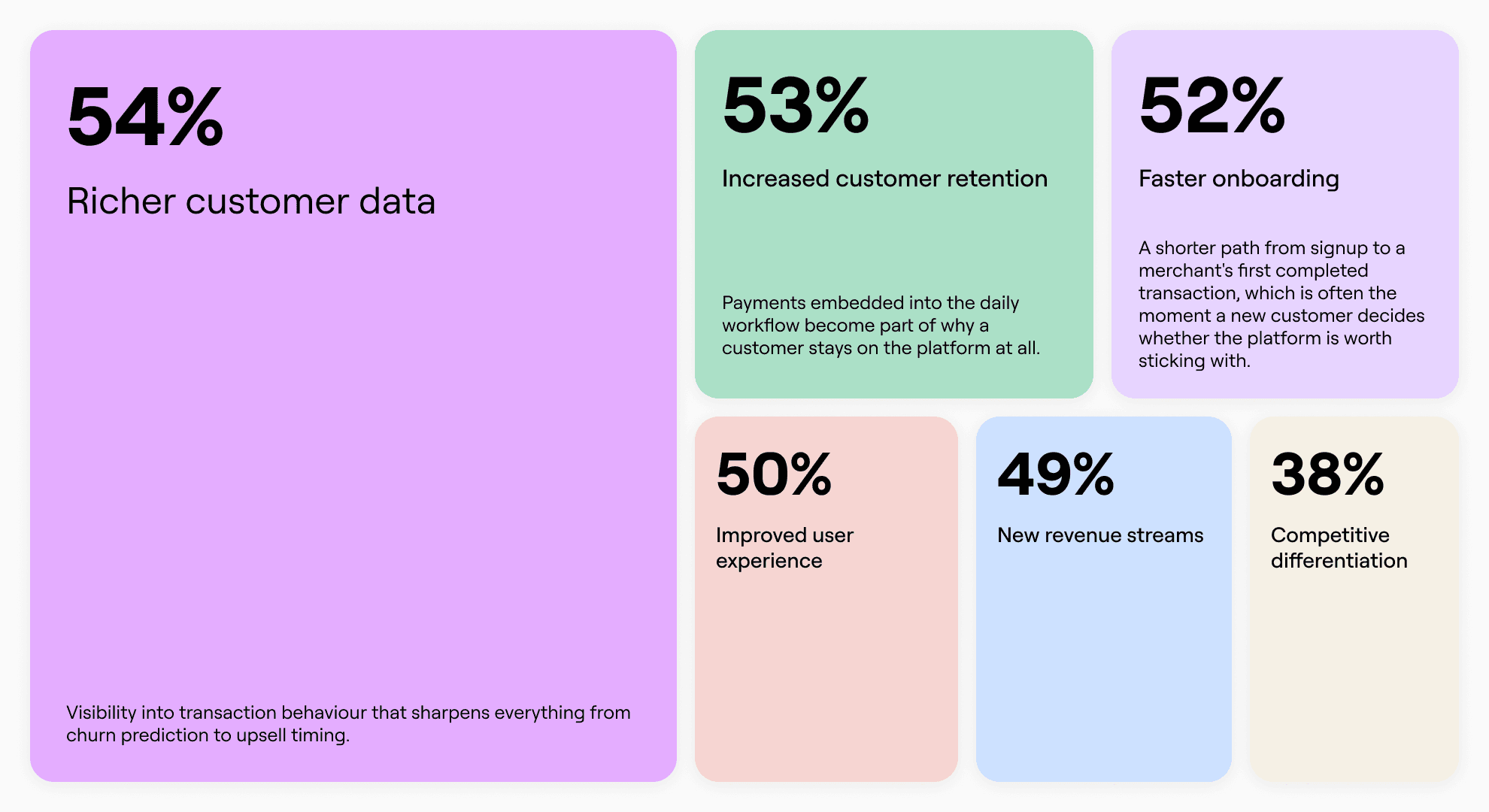
Richer customer data — 54%. Visibility into transaction behaviour that sharpens everything from churn prediction to upsell timing.
Increased customer retention — 53%. Payments embedded into the daily workflow become part of why a customer stays on the platform at all.
Faster onboarding — 52%. A shorter path from signup to a merchant's first completed transaction, which is often the moment a new customer decides whether the platform is worth sticking with.
Improved user experience — 50%.
New revenue streams — 49%.
Competitive differentiation — 38%.
These compound on each other. Better data sharpens decisions. Faster onboarding builds early trust. Trust and a good experience drive retention. Retention is the cheapest growth a SaaS platform can buy, because it doesn't require new acquisition spend.
Can payments actually help with international expansion?
Currently, 25% of SaaS leaders see payments as a barrier to international growth, usually because of differing regulatory requirements, local payment preferences, and onboarding processes between markets. That's worth naming honestly. But it's also worth reframing: this is a solvable infrastructure problem, not a fixed cost of expanding.
A platform with a single KYC process, broad local payment method support, and compliance built in across markets removes most of this friction before it shows up. Expansion stays a go-to-market decision, where it belongs, instead of becoming an unplanned infrastructure project halfway through a deal. For the 64% of leaders who already see payments as a growth lever, getting the international piece right is one of the more direct ways to put that belief into practice.
How fast can a platform innovate once payments are set up right?
One of the clearest signs of a healthy payments setup is speed. 78% of platforms can launch or modify a payments-related feature within four weeks. The remaining 22% typically need one to three months, usually because they're waiting on their provider rather than their own team.
That four-week benchmark matters because it changes what's possible. A platform that can ship a new payment method, a new pricing model, or a new market's compliance requirement in weeks rather than months can treat payments as a genuine product lever, something to experiment with and iterate on, rather than a fixed piece of infrastructure to work around.
What does this look like for a real platform?
Retaildesk wanted to turn payments into a real part of their product offering across two SaaS labels, Retaildesk and Gastrodesk, covering online invoicing, QR code payments, and Tap on Mobile, with split payouts for franchise structures. Rather than treating payments as a back-office function, OPP gave them one integration with the platforms' Laravel-based backend, one onboarding flow including verification and contract signing, and SoftPOS support for in-person transactions.

As co-founder Rick Bertoen put it:

"OPP not only actively thinks along with us on the technical side, but also on compliance, user onboarding, and payout flows. This makes them a true sparring partner that is also open to developing new possibilities together."
Co-founder of Retaildesk, Rick Bertoen
That's payments functioning as a growth partner, not just a processor.
What should SaaS platforms look for in a growth-ready payments partner?
Based on what's separating the platforms capturing this upside from the ones still leaving it on the table, four things matter most:
A single onboarding and compliance process. One KYC flow covering online, Tap on Mobile , and terminal payments, so growth into new payment types or markets doesn't mean starting from scratch each time.
Branded, white-label capability. Payments that feel like a native part of the platform, not a redirect to someone else's checkout, so every transaction reinforces the platform's own brand.
Flexible, controllable pricing. Pricing models that can be tailored by merchant type, transaction type, or volume, plus support for splitting payments across multiple parties as the business model gets more complex.
Licensing and market coverage that scales with you. A provider holding its own PayFac licence removes the need to obtain one independently when expanding, keeping growth on the platform's own timeline.
What does this mean for your platform?
Depends where you are right now:
If you haven't embedded payments yet: the data is clear that this is no longer optional for competitive SaaS platforms. The question isn't whether to do it, but who you do it with. Start by asking any provider you're evaluating whether they were built for platform business models or ecommerce.
If you have embedded payments but haven't monetised them: run a quick audit. Do you control your own transaction fees? Can you see your transaction data directly? How long would it take to add a new payment method? If the answers are "no," "not really," and "months," you're leaving real revenue on the table.
If you're expanding into new markets: map the payments requirements before the first deal closes in that market, not after. Regulatory requirements, local payment methods, and onboarding processes all differ by country.
If you serve merchants who operate in person: the hardware constraint is gone. Tap on Mobile means you can now offer in-person payments through your platform without procurement cycles or terminal logistics.
Read the full whitepaper
This article draws on findings from "Traditional Payments are Restricting SaaS Growth" based on a survey of 225 SaaS decision-makers across the Netherlands, France, and Germany. The full whitepaper includes the complete country-level data breakdown and more detail on how platforms are turning payments into a strategic growth lever.
FAQ
Can payments really be a revenue driver for a SaaS platform, not just a feature?
What's the difference between a standard PSP and a payments provider built for platform growth?
Does international expansion always create payment problems?
Are in-person payments part of this growth opportunity too?
How quickly can a platform start capturing more value from payments?

Hyunji Kim
Content & PR Lead